
Critical Activities Validation It is based on the latest trends in society and the technology that connects us more easily and efficiently.
It is aligned with the regulatory standards defined by current legislation.
It is focused on addressing the high demand from stakeholders in the workplace for the continuous prevention of accidents, through employee instruction and training in topics such as critical activities—considered either legal requirements or life-risk issues—and being able to verify the status of these trainings.
VAC is a simple, practical, and efficient tool.
VAC is aligned with the regulatory standards defined by current legislation.
VAC is EASY to use.
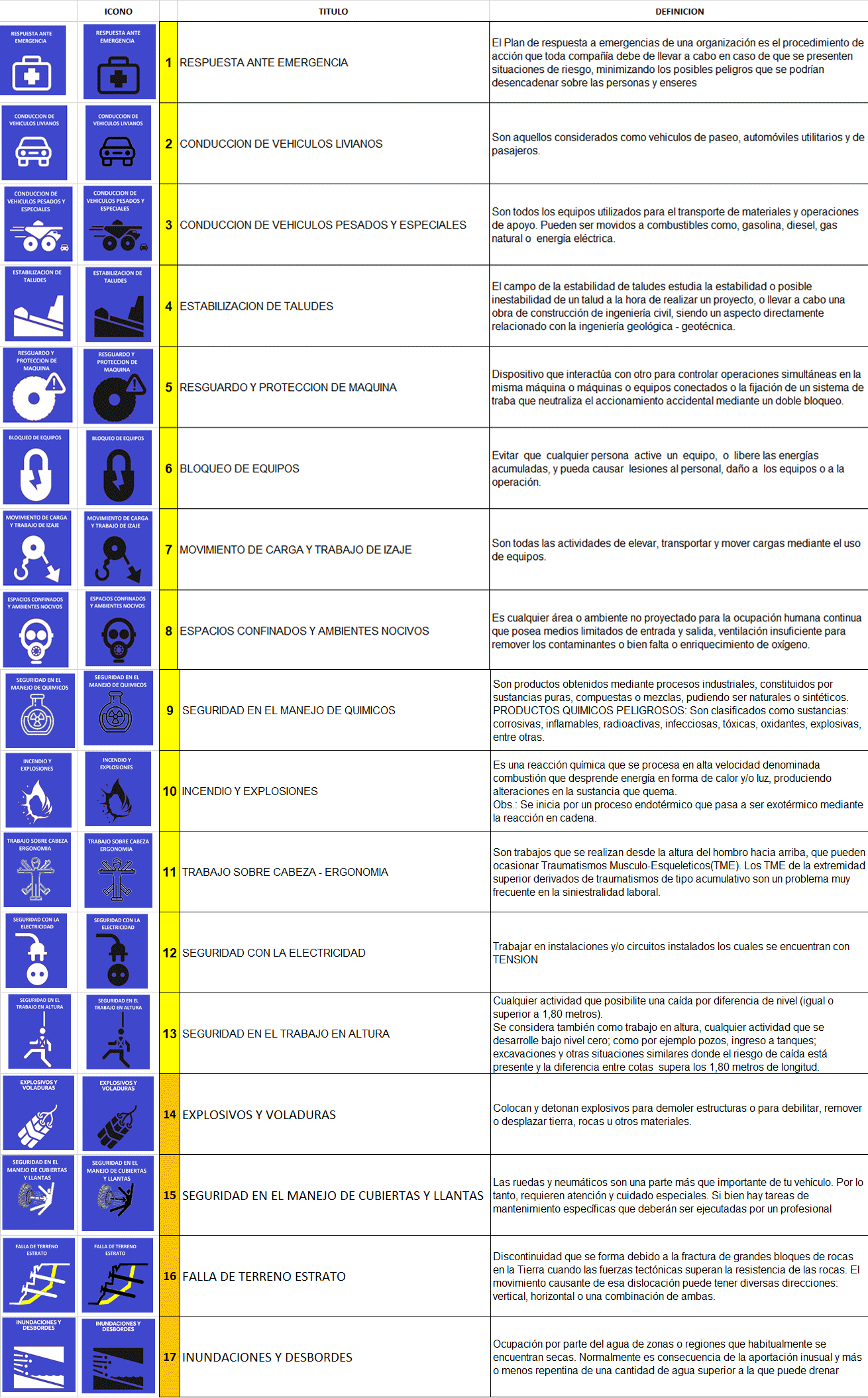
A Critical Activity is an activity defined as dangerous, requiring a specific protocol to be carried out—mandatorily and without exception—to ensure the safety of individuals, protect their physical integrity, and safeguard the health of those exposed to it.
A critical task is a set of critical activities performed simultaneously.
Example: a person who needs to paint a building (handling chemicals) on scaffolding (working at heights)
Proper and thorough hazard identification and risk assessment (HIRA) leads to the identification of the critical activities to which a worker will be exposed, making training times effective and focused. This is how we manage ACCIDENT PREVENTION.
All Critical Activities require formal training by a person/instructor who has the necessary qualifications to conduct the training and record it.
The legislation covering critical activities includes all regulations related to workplace safety and hygiene, whether at the national legal level or foreign or global standards to which the company or establishment adheres.
WORKERS’ RISK INSURERS (ART) are insurance companies contracted to provide employees/policyholders with primary and necessary care in the event of any workplace incident that threatens their life or affects parts of their body.
Hygiene and safety services are hired (internally or externally) by the company or institution to identify hazards, analyze risks, advise the organization’s community on these matters, and provide the necessary training to align all members of the advised group.
An employee can be affiliated with one union, typically the one most aligned with the activity they perform.
An employee can use the VAC service without being affiliated with a union (outside of an agreement); inclusion of these cases depends on each company or institution.
An employee who moves to another company or institution retains their training status, validity, and electronic records in the app.
If an employee moves to another province to join a new company or institution, they retain their training status, validity, and electronic records in the app.
If an employee moves to another country to join a new company or institution, they retain their training status, validity, and electronic records in the app.
The current company or institution is responsible for uploading the trainings it provides to its employees.
The current company or institution must decide whether to accept the trainings the individual brings from the previous company or provide updated trainings, even if the existing ones are still valid.
In Argentina, Article 30 of the Employment Contract Law establishes that a company hiring third-party services may be held jointly liable for labor and social security violations committed by its contractors with respect to the personnel assigned to the delegated activity.
The regulation requires verifying, at a minimum, each worker’s employment identification, proof of salary payments and social security contributions, confirmation of a bank account in the contractor’s name, and valid workers’ compensation coverage. Failure to control any of these elements may constitute noncompliance and expose the hiring company to potential claims.
In practice, meeting the minimum legal requirements does not always guarantee full protection. Some legal interpretations consider that if a labor violation ultimately occurs, the control performed was insufficient, potentially triggering joint liability regardless of prior verification efforts. For this reason, companies need more than simple document collection. They require a system that allows them to verify, update, and reliably document every control action performed.
Implementing VRL professionalizes this process, reduces exposure to joint liability, and transforms a legal obligation into a proactive risk management strategy.